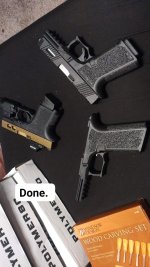
Building the new Bridge (76%) frame ?

Now for the hardest part. Lower section of the trigger housing. I have not come up with a method or technique for this area. It would have been nice if only the upper area had the waffle fins. They go all the way down to the ridge the rail sets on. I currently don’t see anyway to save that platform. This frame is already too far gone to even attempt it.
These are the issues:
1) Very little room. Dremel doesn’t fit down in there without damaging the surrounding areas. I went down as far as I dare with tool extended out all the way. Hot knife damages surrounding area…no room to move.

2) Can’t see down in there. Tools take up all the space, no light or room to see what’s happening in there.

Anyone have ideas to get down into the trigger housing ?

@Michele

Hmmm. What you describe here seems quite troubling for relying on a Dremel and the small length bits..

Do you have a drill press?
I would say the way to maybe tackle that would be to perhaps chock it up in the original jig and square it up on the drill press table. Then plunge with an end mill bit that has a flush cut like described in an earlier link by another member. But, I'm thinking those tiny mill bits are not that long enough.

See the photos below.

These two pics are for quick illustration purposes here and I slapped a jig on the drill press table because I'm pressed for time working in the shop for a race next weekend. But, in the second photo, you can see the lower shelf area for the rear locking block and you have some access with it inside an original jig. This is a PF45 jig. It's the only frame I have that isn't built, so I used this one to illustrate. You might need to cut out some of the top of the red jig to be able to plunge deep enough, but on first glance, this area where you would remove material on the red jig doesn't appear critical.

This is the only way I can think of immediately that would afford good control in a tight area and I do believe you need to get the depth correct too and don't go at it willy nilly. The locking block rests on that shelf and you may have ground away some of the other support it has in the arched area, so getting the depth right is probably necessary.

Thanks again for all your effort here. Looks like you have all the tools to tackle this in a variety of ways.


drill_press_1280t.jpg


pf45_downview.jpg
 
Here is the area where you might remove some red jig material to gain better access (the black rectangle area). You may not need to remove this much. I just drew it up quick. I know this maybe sounds like a PITA, but it would probably result in a square flush cut on the shelf where the RLB rests.

pf45_downview_arrow.jpg
 
Update:
Here’s where I am so far. This frame is so beat up, it’s surely not FTQ. I suggest protecting areas to avoid melting them or getting Dremel wear marks. I’m really not sure how I am going to get down into that trigger housing without damaging the frame worse than it already is.

View attachment 9811

Front locking block obstructions were not difficult to remove at all. The back leg area- used the ryobi chisel to cut straight down then cut off from the horizontal platform with my diy 90* hot knife.
View attachment 9817

Front leg area of the locking block I used the ryobi chisel and Dremel diamond straits to clean it out.
View attachment 9816


The locking block fits so far, real test will be after I remove the tabs.
View attachment 9819


Now for the hardest part. Lower section of the trigger housing. I have not come up with a method or technique for this area. It would have been nice if only the upper area had the waffle fins. They go all the way down to the ridge the rail sets on. I currently don’t see anyway to save that platform. This frame is already too far gone to even attempt it.
These are the issues:
1) Very little room. Dremel doesn’t fit down in there without damaging the surrounding areas. I went down as far as I dare with tool extended out all the way. Hot knife damages surrounding area…no room to move.

2) Can’t see down in there. Tools take up all the space, no light or room to see what’s happening in there.
View attachment 9818

Tools used left to right: Drill master and pink grinding bits from harbor freight, x-acto knife, stipple iron 60W turned up to max temp, hot knife 30W turned up to max, ryobi chisel.
View attachment 9812


Dremel bits used.
View attachment 9820

This frame is definitely a challenge. Getting FTQ in the trigger housing area not so easy. I have definitely learned from the mistakes I’ve made. The hot knife is nice it works pretty well. Need the 90* to get a nice looking shelf for the locking block to set on. I also like the electric chisel it cuts fairly quickly in straight lines. I will use both tools on my next frame.

Anyone have ideas to get down into the trigger housing ?
Nice work, not only in getting this towards functional without relying on your friendly neighborhood rottweiler, as the Reddit folks seem to be doing, but in trying out different techniques and tools as well. This is nothing short of innovation, and the very definition of Leadership.
I am glad to hear that the FRLB pocket-plugs were not too difficult to remove. I'm not 100% sure I am reading you right here, but if it helps, the ONLY ridge your Rear Rail component needs to rest on is the outer edge of the rear arch.
1678000188880.png

Any horizontal 'shelf' at the bottom is I believe irrelevant, perhaps even obstructive, even in the earlier 80% forms, and do not define Rail height, again this is done by the rear arch. The Trigger Housing Pin can assist in holding this position, but really just holds everything in place. The forward Trigger Housing pocket wall, that separates the pocket from the magwell, is also very important for aligning the Trigger Housing and Rails to the horizontal and vertical planes, but nothing at the bottom of the TH pocket matters, so long as it is clear enough for the parts to fit in.
 
Last edited:
I dare say that "76%" to describe the new "compliant" or "bridge" frame is a bit OPTIMISTIC.

"76%" would imply only 4% more effort / work than the original "80%." It would appear that it's a LOT more than a mere 4% additional work.

They should call it a 66% frame, and even that may be generous or optimistic.
 
Roger that @GSW10 very helpful. I was fully stumped on how to get down in there.

With this info I will attempt to cut it out employing these tools with the straight blade.

The hot knife / stippling iron works ok but the shaft is hot. Easily melts parts unintentionally. In addition the knife is not as hot as I would like. Employing the X acto knife method the only hot part is the blade which allows more control of what is heated.
1678041891456.jpeg
 
I dare say that "76%" to describe the new "compliant" or "bridge" frame is a bit OPTIMISTIC.

"76%" would imply only 4% more effort / work than the original "80%." It would appear that it's a LOT more than a mere 4% additional work.

They should call it a 66% frame, and even that may be generous or optimistic.
When the 80% first came out I’d bet there was much more that 20% effort by builders to complete it.
Once techniques are found that will get FTQ on this frame it’ll be easier/quicker. I can report the locking block obstructions are not difficult at all. The trigger housing needs a bit of massaging to get it. I’m curious what MGB has worked out for the lower area. His clipping method can get the upper bulk out nicely.
 
So heres a couple other ideas I have.

I may try it on the rear rail after I attempt to remove the lower grids.
How bout this ? Heat up the rear rail with my heat gun and press it in place.
At what temp point will I change the hardness ? Do I need to be concerned with that ?

Make some 3D printed sanding tools that will fit down in the channel and on the rear rail area to smooth out after using Dremel like @AKfishwhisperer did his.

@AKfishwhisperer hows it going with your build. Would like to hear how you’re going. Anyone else doing a build or have ideas ? Post em up ! We can help each other.
 
Cleaning out the bottom portion of the trigger pocket is impossible without tearing up the walls down there. Polymer 80 needs to revise this frame and make the grills stop just before the narrow portion. I hope I'm wrong but so far no one has been able to pull it off and make something presentable.
 
Cleaning out the bottom portion of the trigger pocket is impossible without tearing up the walls down there. Polymer 80 needs to revise this frame and make the grills stop just before the narrow portion. I hope I'm wrong but so far no one has been able to pull it off and make something presentable.
Personal experience, too? Got photos?

Thanks for joining the forum and participating by posting! When you get a chance, please write up a quick “introduction” (or RE-introduction if you were a former MGB forum member) of yourself over in the Introduce Yourself! section. Tell us about yourself, your building experience, and how you found the forum.

Jump into other threads, too! Come on in... the water's fine! 😊
 
Cleaning out the bottom portion of the trigger pocket is impossible without tearing up the walls down there. Polymer 80 needs to revise this frame and make the grills stop just before the narrow portion. I hope I'm wrong but so far no one has been able to pull it off and make something presentable.
Yep, that’s a fact. Dremel, chisel, & stipple iron can only go down so far before it’s useless. Will need some diy custom tooling to get to it.
 
So heres a couple other ideas I have.

I may try it on the rear rail after I attempt to remove the lower grids.
How bout this ? Heat up the rear rail with my heat gun and press it in place.
At what temp point will I change the hardness ? Do I need to be concerned with that ?

Make some 3D printed sanding tools that will fit down in the channel and on the rear rail area to smooth out after using Dremel like @AKfishwhisperer did his.

@AKfishwhisperer hows it going with your build. Would like to hear how you’re going. Anyone else doing a build or have ideas ? Post em up ! We can help each other.
Hello Michele and everyone else. Sorry I haven't had time in the last few days because of work and ongoing doctors appointments.
 
Here she is…..I could keep at by doing a few more repairs on the polymer then FTQ that trigger housing by sanding and polishing. Far as I’m concerned this one is done. I have no plans to build it out. Interesting experiment. I have another frame which I will start in a few days. Using lessons learned from this one, the next should come out better.

E8A3603F-F8E1-4035-B5CA-7A032E7A3359.jpeg

Both rails are seated down properly. The front rail wasn’t quit down fully. Was a hair high. I heated the the front legs with my heat gun a bit and pushed er in. The block went right in like budda and is set in nice.

Same with the rear rail. After cleaning out the lower area of the trigger housing the best I could the rail was high a good 1/16 inch. Instead of playing around with trying to find the high spots in “the dark cave” I opted for a hot press in. Heated the rear rail with the heat gun carefully slid it in as not to damage the surrounding polymer. Pressed it in, repeated again, It set down in nice on the 2nd try
6FB9C03A-AD1F-4E69-B9EB-E7B4655B51F9.jpeg


3221C4A3-8239-4F4C-9DE5-EB8549F6BC80.jpeg

Due to my lack of protecting the frame edges some areas were really beat up horribly. Damaged by the Dremel and melted by the hot knife or stipple iron. I repaired the 2 worse areas with material from the frame. Although it looks pretty rough here, most of it can be polished and more repairs can be done to bring this to a respectable look. However, I’m pretty sure this frame would perform fine as a weapon if completed as is.

18955AED-4A12-4D87-A844-582723A7796C.jpeg


I’ll start a new post when I get going on the next one.
Final thoughts
This frame is not for the faint of heart. It’s for the hobbyist that enjoys working with their hands, tools and likes detail. If you want to slap something together….this is not it. You will need patience to get into the lower area of the trigger housing to do a decent job of it. The forward block was fairly easy to complete with hot knife, carving tool, Dremel small ball bit and or the diy 90* hot knife.

Good luck to everyone building these new bridge frames. The only real hard part is the lower area of the trigger housing.
 
Here she is…..I could keep at by doing a few more repairs on the polymer then FTQ that trigger housing by sanding and polishing. Far as I’m concerned this one is done. I have no plans to build it out. Interesting experiment. I have another frame which I will start in a few days. Using lessons learned from this one, the next should come out better.

View attachment 9882
Both rails are seated down properly. The front rail wasn’t quit down fully. Was a hair high. I heated the the front legs with my heat gun a bit and pushed er in. The block went right in like budda and is set in nice.

Same with the rear rail. After cleaning out the lower area of the trigger housing the best I could the rail was high a good 1/16 inch. Instead of playing around with trying to find the high spots in “the dark cave” I opted for a hot press in. Heated the rear rail with the heat gun carefully slid it in as not to damage the surrounding polymer. Pressed it in, repeated again, It set down in nice on the 2nd tryView attachment 9883

View attachment 9885
Due to my lack of protecting the frame edges some areas were really beat up horribly. Damaged by the Dremel and melted by the hot knife or stipple iron. I repaired the 2 worse areas with material from the frame. Although it looks pretty rough here, most of it can be polished and more repairs can be done to bring this to a respectable look. However, I’m pretty sure this frame would perform fine as a weapon if completed as is.

View attachment 9881


I’ll start a new post when I get going on the next one.
Final thoughts
This frame is not for the faint of heart. It’s for the hobbyist that enjoys working with their hands, tools and likes detail. If you want to slap something together….this is not it. You will need patience to get into the lower area of the trigger housing to do a decent job of it. The forward block was fairly easy to complete with hot knife, carving tool, Dremel small ball bit and or the diy 90* hot knife.

Good luck to everyone building these new bridge frames. The only real hard part is the lower area of the trigger housing.
Looks good
 
Last post on this thread I'll start a new for the next frame and edit in the link. Hope I do much better with it. Attached a PDF for those that want a piece of paper :)

Here she is cut up so you can see what's happened in there.

Lessons learned:
  • Remove the center fin in the grid area of the rear rail before working on the sides. This will allow some room to maneuver to get the left and right grid sections out.
  • Snip or cut grid that is attached to the frame with a flush cut or straight blade before removing the bulk of it.
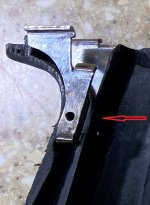
  • The wall, see arrow pictured, is thin and flimsy. Use caution when tooling. Its easy to remove too much, punch through with a razor or bend it out of shape with too much pressure.
cut away.jpg
  • Protect frame near work areas from tool marks. Tape works great. Its easy to grind/rub or cut parts of the frame, polymer is soft and easily damaged.
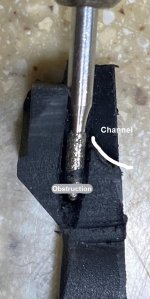
  • The obstruction at the front leg of the locking block is down in the pocket aligned where the pin hole would have been. See illustration. Use caution when tooling so as not to damage the edge of the channel. Cut away from frame with snips, xacto chisel or other straight type tooling.
Inkedblock pocket.jpg
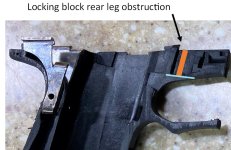
  • The obstruction at the rear leg of locking block is open and easily cut out with dremel, razor, xacto chisel blade or other straight tooling. Use caution and cut just to the rear leg seat (blue line). The seat maybe finished smooth like in LW freedom build. I made a 90* stainless xacto blade cutter used as a hot knife using heat gun to get it hot enough.
rear leg seat.jpg
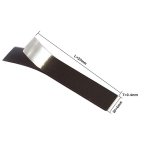
  • Hot knife easily damages frame. Heating exato knife with heat gun works well. 90* blade is available on Amazon. DIY blade is much less expensive and simple to make from stainless.
D679F137-71AC-462E-AA68-5567B6908348.jpeg
page01.jpg

page02.jpg

page03.jpg


Frame #2 thread
 

Attachments

  • bridge frame.pdf
    5.8 MB · Views: 378
Last edited:
Cleaning out the bottom portion of the trigger pocket is impossible without tearing up the walls down there. Polymer 80 needs to revise this frame and make the grills stop just before the narrow portion. I hope I'm wrong but so far no one has been able to pull it off and make something presentable.
I did🤷
 

Cool. Do share! Let's see brightly-lit photos of the inside of the finished pocket. Also, how did you do it? Tools?

Thanks for joining the forum and participating by posting! When you get a chance, please write up a quick “introduction” (or RE-introduction if you were a former MGB forum member) of yourself over in the Introduce Yourself! section. Tell us about yourself, your building experience, and how you found the forum.

Jump into other threads, too! Come on in... the water's fine! 😊
 
Last post on this thread I'll start a new for the next frame and edit in the link. Hope I do much better with it. Attached a PDF for those that want a piece of paper :)

Here she is cut up so you can see what's happened in there.

Lessons learned:
  • Remove the center fin in the grid area of the rear rail before working on the sides. This will allow some room to maneuver to get the left and right grid sections out.
  • Snip or cut grid that is attached to the frame with a flush cut or straight blade before removing the bulk of it.
  • The wall, see arrow pictured, is thin and flimsy. Use caution when tooling. Its easy to remove too much, punch through with a razor or bend it out of shape with too much pressure.
View attachment 9990
  • Protect frame near work areas from tool marks. Tape works great. Its easy to grind/rub or cut parts of the frame, polymer is soft and easily damaged.
  • The obstruction at the front leg of the locking block is down in the pocket aligned where the pin hole would have been. See illustration. Use caution when tooling so as not to damage the edge of the channel. Cut away from frame with snips, xacto chisel or other straight type tooling.
View attachment 9994
  • The obstruction at the rear leg of locking block is open and easily cut out with dremel, razor, xacto chisel blade or other straight tooling. Use caution and cut just to the rear leg seat (blue line). The seat maybe finished smooth like in LW freedom build. I made a 90* stainless xacto blade cutter used as a hot knife using heat gun to get it hot enough.
View attachment 9993
  • Hot knife easily damages frame. Heating exato knife with heat gun works well. 90* blade is available on Amazon. DIY blade is much less expensive and simple to make from stainless.
View attachment 10003
View attachment 9984
View attachment 9985
View attachment 9986

Frame #2 thread


The cutaways are useful. Thanks for doing this!(y)
 
How do we feel about going real slow with a narrow (1/8” or smaller) blade on a wiggle-cutter?
 
Back
Top