

Why wouldn't they cheat on the exam, everyone else was.
This generation and maybe a couple before them have normalized cheating since their youth.
Did it start with "cheat codes" from video games? Did they learn it from their parents? Or are they just too lazy and always want the easy way out.
The sad part is, they will just take a different class, with a different prof and hope he either doesn't notice, or doesn't care and just pass them all so the stats look good.
I used to see this at work. Management wanted a certain percentage of work orders completed per day. All the schedulers had to do was put jobs on the schedule that were already completed or nearly so to boost the numbers. Just don't make it look too good and raise suspicion. Throw in a bad day now and then.
One of Cooper's stories on this topic revolved around him and his Masters Degree in History. The exam was oral, in front of a panel of History profs who wanted to see exactly how well the student knew the topic. No multiple choice or True or False questions. What they wanted was for the student to expound.
Now we all know that is never going to happen in today's academia. So, the decline will continue until AI is the only place to find the answer. Maybe that was the goal all along.
Bottom line is, Prof Roberto, don't hold your breathe.
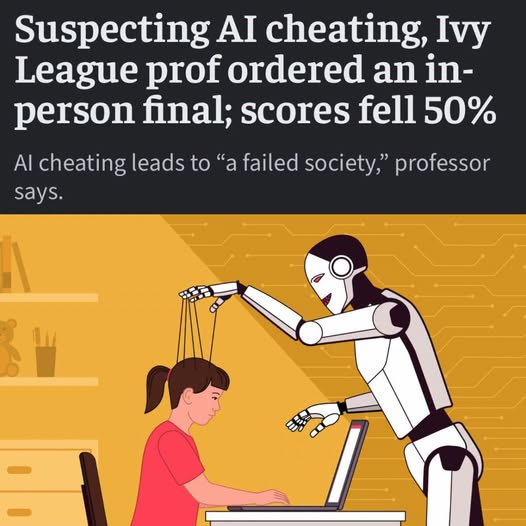
Brown University AI Cheating Scandal Highlights Growing Crisis in Higher Education
In the wake of a campus tragedy, Professor Roberto Serrano of Brown University offered his students flexibility in an advanced mathematical economics course by allowing a take-home midterm.
The results were unprecedented: an average score of 96 out of 100, with 40 students achieving perfect marks.
These outcomes far exceeded historical performance in what is known as a rigorously demanding class.
Suspicious of the outcomes, the professor, a distinguished economist who overcame blindness at age 17 to build an exceptional academic career, noticed that many responses exhibited the convoluted, circuitous style characteristic of generative AI tools.
When tested against ChatGPT, the exam questions produced strikingly similar answers.
Determined to verify genuine understanding, Professor Serrano shifted the final exam to an in-person format.
The response was telling: 18 students dropped the course, nine more failed to appear, and 22 of those 27 had earned perfect scores on the midterm.
For those who took the proctored final, the average score plummeted to 48.
Professor Serrano subsequently voided the midterm grades and estimates that at least 50 students used AI to cheat, potentially the largest known case of its kind in the Ivy League.
Recent surveys at peer institutions like Princeton indicate that nearly 30 percent of students have admitted to using AI for assignments or exams.
At Brown, daily or weekly generative AI use is common, yet many students themselves have shared concerns about its long-term impact on their cognitive development.
Professor Serrano has been vocal about the stakes, stating:
“We cannot afford to have a society in which a significant fraction of our best young minds think that cheating is okay. That leads to a declining society, to a failed society. We cannot choose to become idiots.”
His words are sobering.
As elite universities grapple with the integration of AI, this scandal raises urgent questions about academic integrity and the very purpose of higher education in cultivating critical thinking among the next generation of leaders.
Universities have to confront this reality head-on.
This generation and maybe a couple before them have normalized cheating since their youth.
Did it start with "cheat codes" from video games? Did they learn it from their parents? Or are they just too lazy and always want the easy way out.
The sad part is, they will just take a different class, with a different prof and hope he either doesn't notice, or doesn't care and just pass them all so the stats look good.
I used to see this at work. Management wanted a certain percentage of work orders completed per day. All the schedulers had to do was put jobs on the schedule that were already completed or nearly so to boost the numbers. Just don't make it look too good and raise suspicion. Throw in a bad day now and then.
One of Cooper's stories on this topic revolved around him and his Masters Degree in History. The exam was oral, in front of a panel of History profs who wanted to see exactly how well the student knew the topic. No multiple choice or True or False questions. What they wanted was for the student to expound.
Now we all know that is never going to happen in today's academia. So, the decline will continue until AI is the only place to find the answer. Maybe that was the goal all along.
Bottom line is, Prof Roberto, don't hold your breathe.
Brown University AI Cheating Scandal Highlights Growing Crisis in Higher Education
In the wake of a campus tragedy, Professor Roberto Serrano of Brown University offered his students flexibility in an advanced mathematical economics course by allowing a take-home midterm.
The results were unprecedented: an average score of 96 out of 100, with 40 students achieving perfect marks.
These outcomes far exceeded historical performance in what is known as a rigorously demanding class.
Suspicious of the outcomes, the professor, a distinguished economist who overcame blindness at age 17 to build an exceptional academic career, noticed that many responses exhibited the convoluted, circuitous style characteristic of generative AI tools.
When tested against ChatGPT, the exam questions produced strikingly similar answers.
Determined to verify genuine understanding, Professor Serrano shifted the final exam to an in-person format.
The response was telling: 18 students dropped the course, nine more failed to appear, and 22 of those 27 had earned perfect scores on the midterm.
For those who took the proctored final, the average score plummeted to 48.
Professor Serrano subsequently voided the midterm grades and estimates that at least 50 students used AI to cheat, potentially the largest known case of its kind in the Ivy League.
Recent surveys at peer institutions like Princeton indicate that nearly 30 percent of students have admitted to using AI for assignments or exams.
At Brown, daily or weekly generative AI use is common, yet many students themselves have shared concerns about its long-term impact on their cognitive development.
Professor Serrano has been vocal about the stakes, stating:
“We cannot afford to have a society in which a significant fraction of our best young minds think that cheating is okay. That leads to a declining society, to a failed society. We cannot choose to become idiots.”
His words are sobering.
As elite universities grapple with the integration of AI, this scandal raises urgent questions about academic integrity and the very purpose of higher education in cultivating critical thinking among the next generation of leaders.
Universities have to confront this reality head-on.
